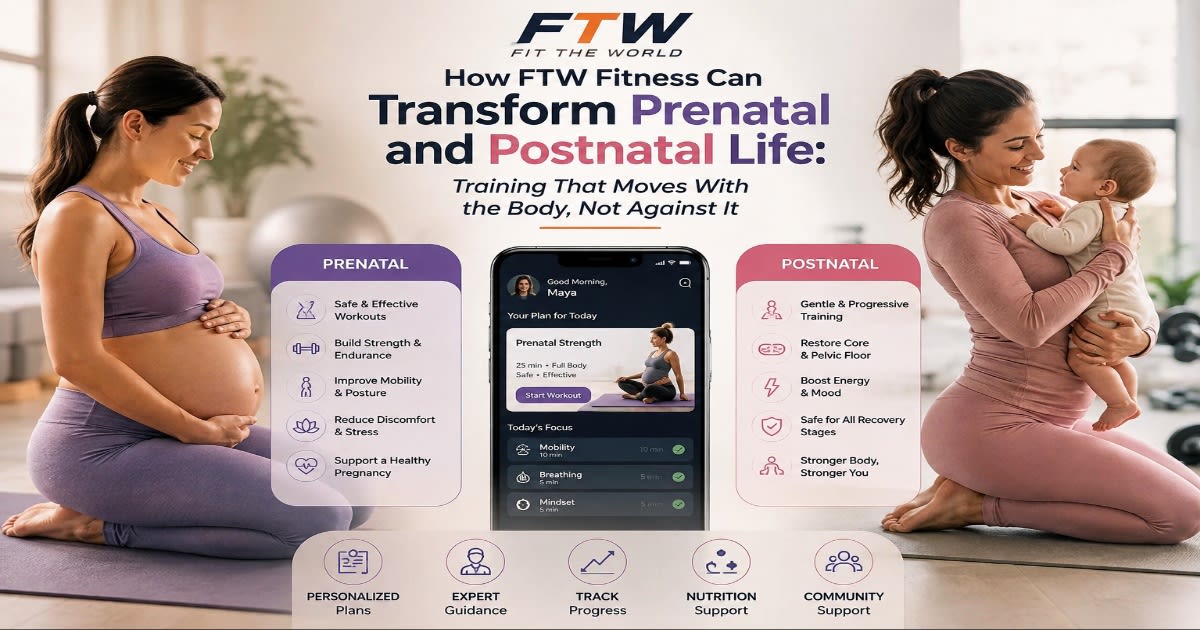
How FTW Fitness Can Transform Prenatal and Postnatal Life: Training That Moves With the Body, Not Against It
*Not medical advice. This content is for general education. Pregnant and postpartum individuals should be under the care of an obstetrician or other qualified provider, who should evaluate any medical or obstetric complications before recommending physical activity.*
Pregnancy and the months that follow put a body through more physiological change than almost any other stretch of adult life. The evidence is clear that movement through this period isn't just safe for most people — it's genuinely protective. The harder question is *how* that movement should be structured, because the body it's designed for keeps changing underneath the plan. That's exactly the problem FTW's prenatal and postnatal system is built to solve.
What the Evidence Actually Shows
The American College of Obstetricians and Gynecologists is unambiguous on the core question: in the absence of medical complications, exercise during pregnancy and postpartum is safe, beneficial, and should be encouraged — with observational research linking it to decreased rates of gestational diabetes, cesarean birth, and operative vaginal delivery, along with faster postpartum recovery time. Current guidance points to at least 150 minutes of moderate-intensity aerobic activity per week, and more recent clinical reviews describe a target of three to four days per week — up to daily — combining aerobic and resistance work at moderate intensity for 30 to 60 minutes per session.
The benefits extend well beyond the delivery room. Structured exercise through this period is associated with reduced excessive maternal weight gain, improved inflammatory and lipid profiles, meaningfully less low-back pain, and — notably — physical activity is considered an important protective factor against postpartum depressive disorders. This isn't a minor footnote: mental health outcomes are one of the most consistently cited benefits in the current research, right alongside the physical ones.
The Catch: The Guidance Itself Says "Individualize"
Here's the detail that should shape how any prenatal or postnatal fitness product is actually built. Recent clinical literature synthesizing this evidence is explicit that these benefits appear "when exercise is individualized, symptom-guided, and appropriately modified" — not when it's handed out as a single fixed plan. That instruction is easy to write in a guideline and genuinely hard to deliver in a real product, because the body a plan needs to serve in week 8 of pregnancy is meaningfully different from the same body in week 30, and different again at three weeks postpartum versus six months postpartum.
A generic prenatal workout plan — the kind built once and handed out at the start — is structurally mismatched to the population it's serving. It either stays too conservative for too long, or it fails to adjust down during the stretches where the body genuinely needs less.
How FTW Is Built for a Body That Keeps Changing
This is where FTW's approach diverges from a standard "pregnancy-safe workouts" library:
What This Actually Changes for Someone's Life
For someone moving through pregnancy and early motherhood, the value isn't a workout — it's confidence that the plan in front of them actually understands where their body is *right now*, not where a generic 40-week template assumes it should be. That matters for the physical outcomes the research points to — lower back pain, better weight trajectory, smoother recovery — but it matters just as much for the mental health side of the picture, where feeling supported and not fighting your own plan is part of the protective effect in the first place.
The research already tells us that individualized, symptom-guided movement is what makes this period safer and more manageable. FTW's job is to make sure that principle isn't just good advice in a guideline — it's the actual, daily experience of using the app.