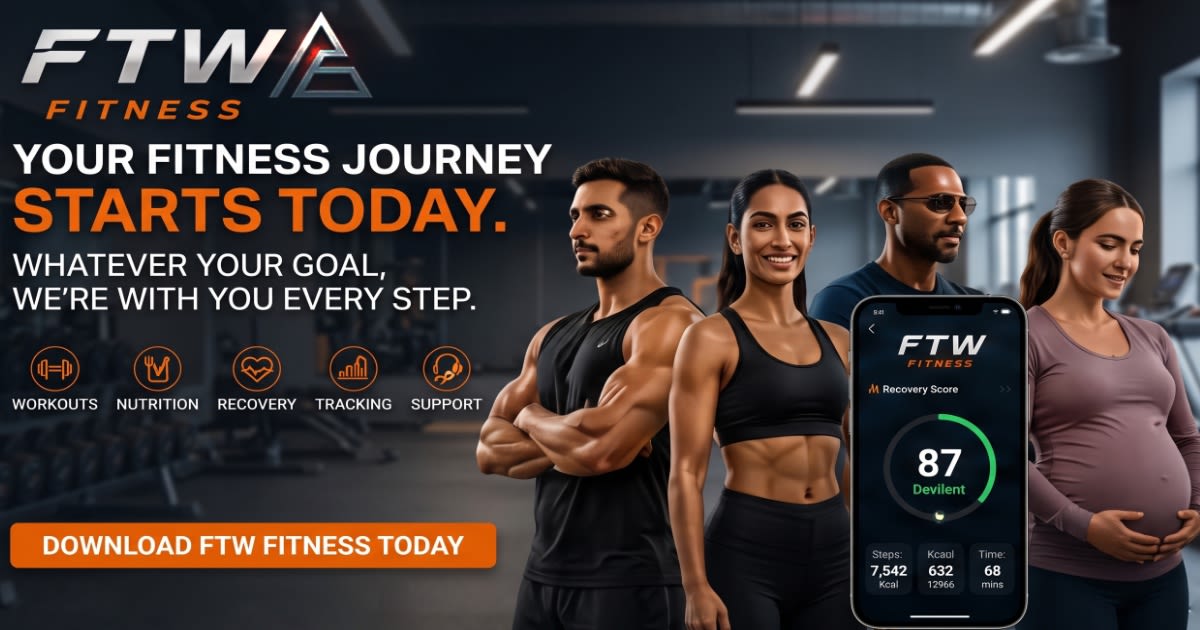
Your Body Already Knows When to Push and When to Rest. Does Your Fitness App?
Most fitness apps treat every day the same. Monday's leg day happens whether you slept four hours or eight, whether you're fighting off a cold, or whether your body is still recovering from Saturday's long run. The plan doesn't care. It just tells you to show up and hit the numbers.
That's not how real training works — and it's not how FTW works.
The Problem With "One-Size-Fits-All" Programming
Traditional training plans are built around a calendar, not a body. They assume you're the same person every day: same energy, same readiness, same capacity to push hard. But anyone who has trained seriously knows that's a fiction. Some days you're primed to hit a new PR. Other days, pushing through is how you end up injured, burnt out, or quietly losing motivation.
The fitness industry has largely responded to this by playing it safe — building conservative programs with wide margins so they rarely ask too much of anyone. It's a reasonable instinct, but it comes at a cost: for a huge number of users, "safe" also means "ineffective." You end up training below your actual capacity most of the time, just to avoid occasionally overreaching.
Enter the Recovery Score
FTW takes a different approach. Instead of guessing at your readiness or defaulting to caution, we built the Recovery Score — an AI-powered daily readiness signal that actually listens to your body.
Every morning, FTW pulls in data straight from your wearable: heart rate variability (HRV), resting heart rate, and sleep quality. These three signals, taken together, are some of the most reliable physiological markers of how recovered your nervous system and muscles actually are — not how recovered the calendar thinks you should be.
That data feeds into your Recovery Score, and the score doesn't just sit there as a number. It actively reshapes your training plan for the day: intensity, volume, and exercise selection all adjust based on where you're really at.
Personalized, Not Just Personalized-Sounding
Here's where it gets more interesting: recovery isn't interpreted the same way for everyone on FTW. Two users with an identical Recovery Score might get different plan adjustments, because FTW also factors in personality and goals.
Someone training for pure performance and comfortable pushing limits might see the plan nudge intensity up on a moderate-recovery day. Someone prioritizing sustainability, injury prevention, or working through a specific health condition might see a more conservative adjustment for the exact same score. The Recovery Score isn't a blunt on/off switch — it's an input into a system that already understands who you are and what you're training for.
Why This Matters as a Differentiator
Most competitors treat recovery metrics, if they use them at all, as informational — a number you glance at and maybe ignore. FTW treats recovery as actionable. The score doesn't just tell you something about your body; it changes what your workout actually looks like that day.
Combined with FTW's willingness to give evidence-based intensity guidance — rather than defaulting to the lowest common denominator the way many competitors do — the Recovery Score becomes part of a bigger philosophy: train hard when your body says you can, back off when it says you should, and never guess.
What's Next
We're continuing to refine how the Recovery Score interacts with subjective feedback — closing the loop between what your wearable tells us and how you actually *feel* after a session. Objective data is powerful, but the best coaching has always combined numbers with lived experience. That's the next frontier for FTW: a Recovery Score that's not just physiologically accurate, but personally attuned.
Because the best training plan isn't the one that looks good on paper. It's the one that meets you where your body actually is — today, not last week, not "on average."
That's the difference between a fitness app and a fitness coach. FTW is built to be the second one.