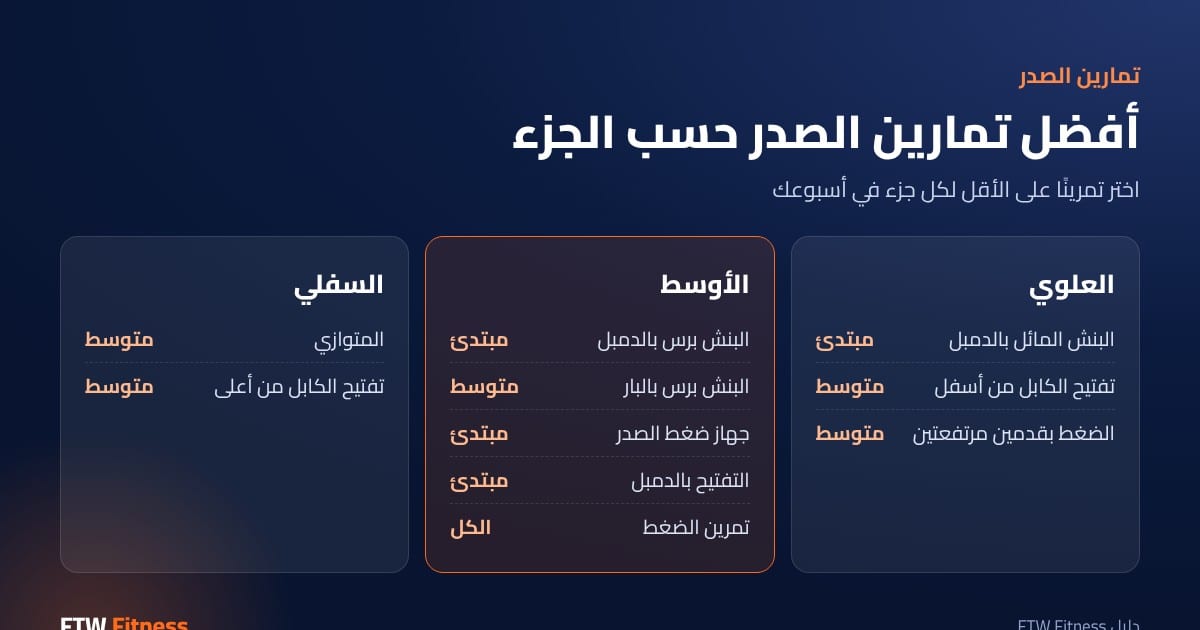
Push-ups are among the best-known and most effective bodyweight exercises for building muscular strength and improving fitness. They don't need any gym equipment or extra weights, you can do them at home or at the gym, and their difficulty levels range from beginners to advanced trainees.
The benefits of push-up exercises aren't limited to strengthening your chest. They also work your triceps, shoulders, and core muscles, which makes them compound exercises that help develop upper-body strength and improve movement control.
Whether you're starting your fitness journey from scratch or looking for a new challenge to improve your performance, this guide gives you the best push-up variations, how to do them, and how many reps suit you each day, with the FTW app helping you organize your training and reach your goals.
First: The Basic Push-Up Variations

Traditional push-ups use your bodyweight as resistance and mainly target the chest, triceps, and front shoulders, with the abs and core muscles working to keep your body stable.
Here are the best-known push-up variations:
1. Standard Push-Up
Start in a high plank position, with your hands on the floor slightly wider than your shoulders, keeping your body straight from your head to your heels. Lower your chest toward the floor by bending your elbows, then push your body back up until you return to the starting position.
2. Wide Push-Up
Similar to the standard push-up, but with your hands placed wider than your shoulders. This change increases how much your chest muscles work; avoid placing your hands too wide, to keep your shoulder joint comfortable.
3. Close-Grip Push-Up
Your hands are closer together than in the standard push-up, which puts relatively more focus on the triceps, while the chest and shoulders keep working.
4. Incline Push-Up

You do it with your hands on a raised, stable surface, such as a bench or a sturdy table, with your feet stepped back. This position reduces how much of your bodyweight your arms carry, which makes it a good option for beginners.
Second: Push-Ups Without Equipment for Beginners and Advanced Trainees
One of the best things about push-ups is that you can progress them without any gym equipment, by changing your body angle, how your weight is distributed, or the speed of the movement.
Exercises for beginners:
- Wall Push-Up: stand facing a wall and place your hands on it, then bend your elbows to bring your chest toward the wall and push yourself back. It helps you learn the movement and build strength gradually.
- Knee Push-Up: start in a push-up position with your knees resting on the floor, and keep your body straight from your head to your knees as you go down and up.
- Negative Push-Up: start from the high push-up position, then lower your body slowly and with control until you're close to the floor. It helps you build the strength you need for the standard push-up.
Exercises for intermediate and advanced levels:
- Diamond Push-Up: place your hands close together under your chest so that your thumbs and index fingers form a shape like a diamond. It makes your triceps work harder.
- Pike Push-Up: raise your hips up to form a shape like an upside-down V, then bend your elbows to lower your head toward the floor. It targets your shoulders more.
- Clap Push-Up: push your body up forcefully until your hands leave the floor and you can clap before landing. It takes a lot of strength and muscular coordination, so it's for advanced trainees only.
- One-Arm Push-Up: done on one arm while keeping your body stable and resisting rotation. It's one of the hardest push-up variations and takes an advanced level of strength and control.
Third: How Many Push-Ups Should You Do a Day?
There's no fixed number of push-ups that suits everyone. The right number depends on your fitness level, your muscular strength, your training goal, and how well you recover.
You can use the following progression as a guide:
- Beginner: start with two or three sets of 5 to 8 reps, using wall or knee push-ups if you need to.
- Intermediate: you can do 3 sets of 10 to 15 reps of standard push-ups.
- Advanced: you can increase the reps or use harder variations, such as diamond or clap push-ups, depending on your physical ability.
These numbers are guidance, not fixed rules, and each trainee can adjust them to their own level.
As for doing push-ups every day, it's possible to do a limited number of reps if the intensity is low and your muscles aren't fatigued, but you don't need to train your muscles hard every day. It's best to leave enough time to recover, especially after intense workouts.
And if your goal is to gain strength or muscle mass, progressing gradually in resistance and reps, while organizing your training and rest days, matters more than trying to reach a big number every day.
Fourth: The Most Common Push-Up Mistakes
To get the most out of push-up exercises and avoid injuries, make sure to avoid these mistakes:
- Arching your lower back: it makes your body lose its straight line, so keep your abs and glutes tight.
- Flaring your elbows out too far: this can put more stress on your shoulder joint; it's better to keep your elbows at an angle that allows a comfortable, controlled movement.
- Not going down through a suitable range of motion: try to reach a range of motion you can control without pain.
- Doing the exercise too fast: controlling the way down and the way up helps improve the quality of the movement.
- Neglecting your breathing: breathe out as you push your body up, and breathe in as you go down.
Frequently Asked Questions
Which muscles do push-ups strengthen?
Push-ups mainly target the chest, triceps, and front shoulders, with the abs and core muscles working to keep your body stable.
How many push-ups should I do a day?
There's no fixed number that suits everyone. A beginner can start with two or three sets of 5 to 8 reps, and an intermediate trainee with 3 sets of 10 to 15 reps. These numbers are guidance, not fixed rules.
Can I do push-ups every day?
It's possible to do a limited number of reps every day if the intensity is low and your muscles aren't fatigued, but you don't need to train your muscles hard every day, and it's best to leave enough time to recover.
What are the easiest push-ups for beginners?
Wall push-ups, knee push-ups, negative push-ups, and incline push-ups on a raised, stable surface; they help you learn the movement and build strength gradually.
What are the most common push-up mistakes?
Arching your lower back, flaring your elbows out too far, not going down through a suitable range of motion, doing the exercise too fast, and neglecting your breathing.
Start From Your Level and Build Your Strength With FTW
You don't need expensive equipment or a gym membership to start building real muscular strength; push-ups give you a way to train your upper-body muscles using only your bodyweight.
What matters most is choosing the right level, sticking to correct form, and making the exercises harder gradually instead of rushing to reach big numbers.
With FTW, you can use your AI-powered personal coach to organize your training, choose the exercises that suit your level and goals, and follow your progress step by step. Start with your first rep, keep improving your performance, and make every exercise a new step toward a stronger body and better fitness!