Chest exercises are among the most important exercises in any program for building muscle and improving physical strength, whether you train at the gym or prefer to work out at home. Strong chest muscles don't just improve how your body looks overall; they also help you perform many everyday movements and upper-body exercises more efficiently.
But what are the best chest exercises for beginners? How can you target your upper chest? And are push-ups enough to build your chest at home, or do you need dumbbells and weights?
In this guide, you'll learn about the best chest exercises, how to perform them correctly, and how to organize a training program that suits your level and goals, along with tips to help you make gradual, safe progress.

The Chest Muscles in Brief: Upper, Middle, and Lower
The chest is made up mainly of the pectoralis major, with the pectoralis minor underneath it. In practice, the pectoralis major is divided into three parts based on the direction of its fibers:
- Upper chest: works more in incline pressing.
- Middle chest: works in flat pressing and standard push-ups.
- Lower chest: works more in decline pressing and dips.
The muscle works as a single unit in every exercise, but changing the angle changes how the emphasis is distributed between its parts.
What Are the Benefits of Chest Exercises?
Chest exercises target a major muscle group in the upper body, and the chest muscles work together with the front shoulder muscles and the triceps during many pushing movements.
The main benefits of training your chest include:
- Increased muscle strength: regular training helps improve your ability to push weights and perform upper-body movements.
- Building muscle mass: resistance training, when done regularly with proper nutrition, can help increase the size of your chest muscles.
- Improved muscle balance: training your chest as part of a balanced program helps develop the upper-body muscles.
- Supporting athletic performance: chest strength plays a role in many sports activities that involve pushing or moving the arms in front of the body.
- Improved ability to perform daily activities: such as pushing doors or moving certain objects.
It's important to remember that the shape of your chest muscles is affected by several factors, including genetics, body fat percentage, nutrition, and your training program, not by one type of exercise alone.
The Best Chest Exercises at the Gym
If you train at the gym, you can take advantage of a variety of exercises using barbells, dumbbells, and machines. It's best to choose exercises that suit your level and your ability to control the movement.
1. Barbell Bench Press
The barbell bench press is one of the best-known compound exercises for building strength and muscle mass in the chest, and it also works the front shoulders and triceps.
How to do it:
- Lie on the bench with your feet planted on the floor.
- Grip the bar with a comfortable grip slightly wider than shoulder width.
- Lower the bar gradually toward the middle of your chest while controlling the movement.
- Push the bar up until your arms are nearly straight, without forcefully locking your elbows.
- Repeat the movement while keeping your body stable.
Tip: If you're a beginner, start with a light weight and learn the correct path of the movement. Use the safety rack or ask a qualified trainer for help when training with heavy weights.
Common mistake: lifting your hips off the bench or bouncing the bar off your chest to finish the rep. This is a sign that the weight is heavier than you can handle.
2. Dumbbell Bench Press
The dumbbell chest press is an excellent option if you want to train each arm independently while using a comfortable range of motion that suits your abilities.
How to do it:
- Lie on a flat bench and hold a dumbbell in each hand.
- Start with the dumbbells beside your chest, with your palms facing forward or at a comfortable angle.
- Push the dumbbells up in a controlled way.
- Lower them gradually to a comfortable level beside your chest.
- Keep your shoulders stable and avoid bouncing the weights or knocking them together.
Choose a weight that lets you complete the required reps while keeping correct technique.
Common mistake: dropping the dumbbells quickly on the way down and losing control at the bottom of the movement.
3. Incline Dumbbell Press
This exercise is used to increase the emphasis on the upper part of the chest, with help from the front shoulders and triceps.
How to do it:
- Set the bench to a moderate incline, usually around 15–30 degrees to start.
- Hold the dumbbells beside your upper chest.
- Push them up while keeping your shoulders stable.
- Lower them slowly back to the starting position.
Raising the bench incline too much can make the front shoulders more involved in the movement, so you don't need a very steep angle to target your upper chest. And if you want to strengthen the shoulders themselves, read our guide to shoulder exercises.
Common mistake: raising the bench to 45 degrees or more, which turns the exercise into more of a shoulder exercise than a chest exercise.

4. Dumbbell Fly
This exercise focuses on the movement of bringing your arms together in front of your body, and it's usually used as an accessory chest exercise.
How to do it:
- Lie on a flat bench holding a light dumbbell in each hand.
- Start with your arms above your chest and a slight, fixed bend in your elbows.
- Open your arms out to the sides gradually until you reach a comfortable range.
- Bring your arms back up while imagining squeezing the muscles together in front of your chest.
Common mistake: lowering the dumbbells so deep that it causes a painful stretch in your shoulders, or using heavy weights that turn the movement into a press.
5. Chest Press Machine
The chest press machine is a good option for beginners, since it helps guide the movement and reduces the need to balance free weights.
Adjust the seat so the handles are at roughly mid-chest level, then push them forward and return slowly to the starting position. Common mistake: shrugging your shoulders toward your ears while pushing, and setting the seat at the wrong height.
The best chest exercises summarized in one table
| Exercise | Part working most | Equipment | Level |
|---|---|---|---|
| Barbell bench press | Middle | Barbell and bench | Intermediate |
| Dumbbell bench press | Middle | Dumbbells and bench | Beginner to intermediate |
| Incline dumbbell press | Upper | Dumbbells and incline bench | Beginner to intermediate |
| Dumbbell fly | Middle | Light dumbbells | Intermediate |
| Chest press machine | Middle | Machine | Beginner |
| Standard push-up | Middle | Bodyweight | Beginner to intermediate |
| Decline push-up (feet elevated) | Upper | Bodyweight and a stable surface | Intermediate to advanced |
| Low-to-high cable fly | Upper | Cable | Intermediate |
Upper Chest Exercises: How Do You Target the Upper Chest?
The pectoralis major is made up of fibers running in different directions, and you can change the angle of some exercises to adjust the relative emphasis on different parts of the muscle. However, you can't completely isolate one part of the chest.
If your goal is to develop your upper chest, you can include the following exercises in your program:
- Incline dumbbell press: one of the best options for training the upper chest.
- Incline barbell press: lets you progress the weight once you've mastered the movement.
- Decline push-up (feet elevated): makes the push-up harder and changes how the effort is distributed, but it also increases shoulder involvement, so it isn't the best option for everyone.
- Low-to-high cable exercises: let you train the movement of bringing your arms together toward the upper chest.
You don't need to do all of these exercises in a single session. Choose one or two based on your training level, and focus on gradual progression and recovery between sessions.
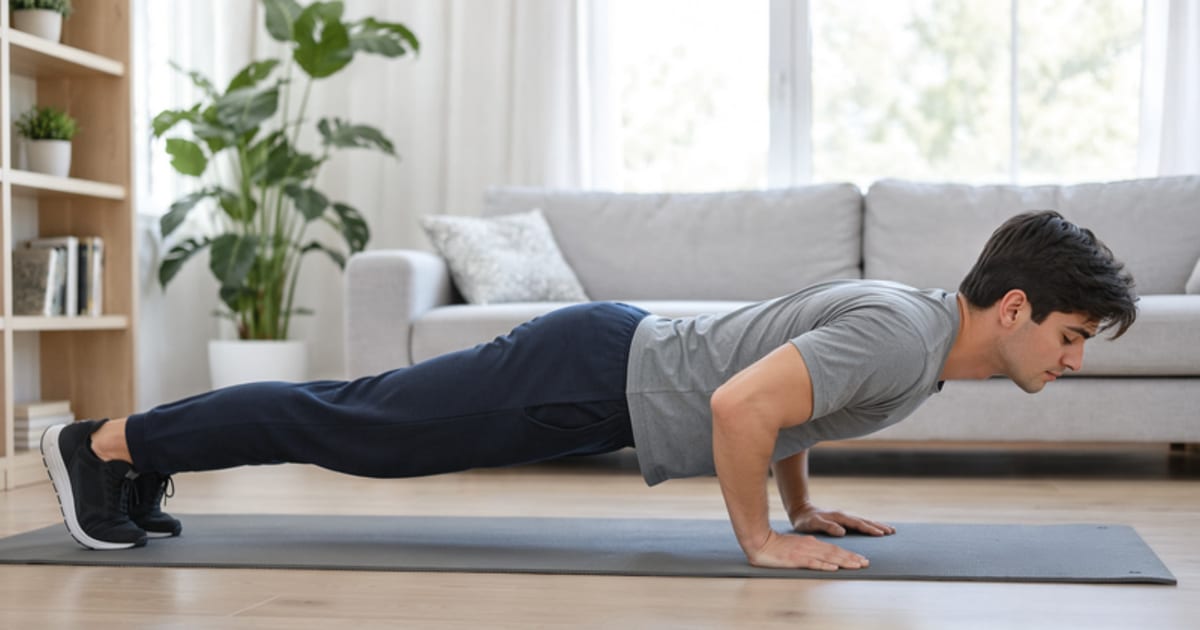
Push-Ups: The Best Options for Training Your Chest With Bodyweight
Push-ups have the advantage of not needing any equipment. One study found that push-ups and the bench press, at comparable intensity, produce similar strength gains [3], and their difficulty can be adjusted to suit beginners or more advanced trainees.
1. Standard Push-Up

This targets the chest muscles, with help from the front shoulders, the triceps, and the core muscles to stabilize the body.
How to do it:
- Place your hands on the floor, from slightly narrower than shoulder width to slightly wider.
- Keep your body in a straight line from head to heels.
- Bend your elbows and lower your chest toward the floor with control.
- Push the floor away to return to the starting position.
- Keep your abs tight and avoid letting your lower back sag.
2. Incline Push-Up

If you find standard push-ups hard, place your hands on a stable, raised surface, such as a sturdy bench or a suitable training table.
The higher the surface, the smaller the share of your bodyweight you usually need to push, which makes the exercise easier. Make sure the surface is stable before you start.
3. Decline Push-Up (Feet Elevated)
In this version, you place your feet on a stable, raised surface and your hands on the floor. This makes the exercise harder and changes how the load is distributed across your upper-body muscles.
Start with a low height if you can already do standard push-ups with good technique, and stop if you feel pain in your shoulder or wrist.
4. Close-Grip Push-Up
Your hands are placed closer together than usual, which usually increases triceps involvement alongside the chest. You don't need to press your hands tightly together; choose a comfortable position that keeps your wrists straight.
Chest Exercises at Home and With Dumbbells
You can train your chest at home even if you don't own weights or a workout bench. The basic idea is to choose a suitable level of resistance, then progress it gradually as the exercise gets easier.
Here are some practical options:
| Exercise | Suitable level | Equipment |
|---|---|---|
| Incline push-up | Beginner | A stable, raised surface |
| Standard push-up | Beginner to intermediate | No equipment needed |
| Decline push-up (feet elevated) | Intermediate to advanced | A stable surface |
| Dumbbell floor press | Beginner to intermediate | Two dumbbells |
| Dumbbell bench press | Depends on ability | Two dumbbells and a stable bench |

Can you build your chest at home?
Yes, you can build your chest muscles at home with the right resistance exercises and gradual progression in difficulty. You can increase the challenge by improving control of the movement, increasing reps within a suitable range, using dumbbells, or gradually moving to a harder version of the exercise.
But if the exercises become too easy and you can no longer increase the challenge in a suitable way, you may need more resistance or additional equipment to keep progressing.
Avoid using bags or household items that are unstable or not designed to bear weight, because this can increase the risk of injury.
Chest Exercises for Beginners: How to Start the Right Way
If this is your first experience with chest exercises, you don't need to do a large number of exercises or train to exhaustion. It's better to build a good foundation of technique, stability, and gradual progression.
Start with the following tips:
- Learn the movement before adding weight: use a weight that lets you control every rep.
- Start with a limited number of exercises: two or three exercises per session is usually enough.
- Choose a suitable training volume: you can start with two sets per exercise, then increase the sets gradually based on your ability to recover.
- Leave time for rest: you don't need to train your chest hard every day; usually leave about 48 hours or more before training it hard again.
- Pay attention to nutrition: your muscles need enough energy and protein to support recovery and growth.
- Don't ignore pain: normal muscle fatigue is different from sharp pain in the shoulder, chest, or wrist. Stop the exercise if unusual pain appears.
Beginner chest workout at the gym
You can use the following table as a starting point that you can adjust:
| Exercise | Sets | Reps |
|---|---|---|
| Chest press machine | 2 | 8–12 |
| Flat-bench dumbbell press | 2 | 8–12 |
| Incline dumbbell press | 2 | 8–12 |
Choose weights you can control, and rest about 60–120 seconds between sets, or longer if you need it to maintain good form.
This is a starter template, not a mandatory schedule for everyone. Exercises can be reduced or adjusted based on experience, physical ability, and available equipment, and it's best for beginners to learn correct technique with the help of a qualified trainer when possible. To see how to fit chest exercises into a full-body week, check out our 3-day beginner gym workout schedule.
Beginner chest workout at home
If you train at home without weights, try the following template:
| Exercise | Sets | Reps |
|---|---|---|
| Incline push-up | 2 | 8–12 |
| Standard push-up or its modified version | 2 | 6–12 |
| Push-up with a slow lowering phase | 2 | 6–10 |
If you can't complete the target number with correct technique, reduce the reps or choose an easier version. And if standard push-ups are easy, you can progress the exercise gradually instead of adding a large number of reps without purpose.
Weekly chest program for intermediate trainees
If you've trained regularly for 6 months or more, you can split your chest training into two sessions a week. Training a muscle twice a week often produces better growth than once a week at the same volume [2]:
| Session | Exercise | Sets × reps |
|---|---|---|
| Session 1 (strength) | Barbell bench press | 3 × 6–8 |
| Session 1 (strength) | Incline dumbbell press | 3 × 8–10 |
| Session 1 (strength) | Push-up | 2 × max reps with correct technique |
| Session 2 (volume) | Flat dumbbell press | 3 × 10–12 |
| Session 2 (volume) | Low-to-high cable fly | 3 × 12–15 |
| Session 2 (volume) | Dumbbell fly | 2 × 12–15 |
Leave at least two days between the two sessions, and increase the weight when you complete the top of the rep range in all sets with correct technique [1].
How Do You Choose the Right Chest Exercise Program for You?
There's no single program that suits every trainee. The right plan depends on your fitness level, goal, available equipment, number of training days, and ability to recover.
A beginner may need a few basic exercises to learn well, while a more experienced trainee can use a variety of angles and weights to keep making progress.
This is where the FTW Fitness app can help you find your starting point. You can try the FTW body analysis, BMI, and workout plan quiz and answer questions about your goal, level, activity, and some of your training circumstances to get an initial assessment and preliminary recommendations to help you plan.
And if you're looking for more personalized follow-up, FTW Fitness offers an AI-powered fitness experience to help organize your training and nutrition based on the information and goals you enter, with the ability to adapt the plan to your progress.
Start with what suits your level, not with what looks hardest. Regular training and planned progression matter more than trying to copy advanced programs from day one.
Important Tips for Getting the Best Results From Chest Exercises
To get the most out of your exercises and improve your performance over time, keep these principles in mind:
- Use a comfortable range of motion: lower the weights as far as you can control without pain.
- Control the lowering phase: don't let the weights drop quickly; controlled movement helps you maintain your technique.
- Increase the load gradually: this is the core principle of any progress [1]. When you can complete your target reps easily and with correct form, you can make a small increase in weight or progress the exercise.
- Balance your muscles: don't neglect back exercises, shoulders, and legs when building your weekly program; a strong chest with a weak back pulls the shoulders forward.
- Get enough sleep: sleep and recovery help support performance and adaptation to training.
- Eat a balanced diet: make sure to eat a suitable amount of protein and energy based on your needs and goals.
- Stay consistent: results take weeks and months of regular training and don't depend on a single exercise or a single session.
Common Mistakes When Doing Chest Exercises
Some mistakes can reduce the quality of your training or increase your risk of injury. The most notable include:
- Using more weight than you can actually handle: this leads to losing control of the movement and compensating with improper movements.
- Skipping the warm-up: start with a short general warm-up, then do warm-up sets with light weights before your heavy main sets.
- Flaring your elbows out too much: this can put uncomfortable stress on your shoulders; choose a comfortable angle that suits your body.
- Repeating the same exercise without progressing: if the exercises no longer present a suitable challenge, consider adjusting the resistance, reps, or difficulty level.
- Training only your chest: building a balanced body requires paying attention to the other muscles as well.
- Expecting very fast results: building muscle is a gradual process affected by your program, nutrition, sleep, experience, and individual differences.
Medical note: If you have a previous shoulder or wrist injury, choose your exercises with the help of an appropriate specialist. Unusual chest pain, especially if it comes with shortness of breath, dizziness, or sweating, requires you to stop training and seek urgent medical evaluation.
Frequently Asked Questions
What are the best chest exercises for beginners?
Beginners can start with the chest press machine, the dumbbell press with a light weight, and incline push-ups. The choice depends on physical ability and available equipment, and the most important thing is learning correct technique before increasing the difficulty.
Are push-ups enough to build chest muscle?
Push-ups can help build chest muscle, especially for beginners, if their difficulty is suitable and increases gradually as your strength improves [3]. As you progress, you may need harder versions of the exercise or added external resistance.
What are the best upper chest exercises?
Common options include the dumbbell or barbell press on a moderately inclined bench, and low-to-high cable exercises. These exercises don't fully isolate the upper chest, but they help increase the emphasis on it within a balanced program.
How many times a week should I train my chest?
You can train your chest once or twice a week depending on your total training volume, experience, and ability to recover, and twice is often better for growth at the same number of sets [2]. The most important thing is to distribute your sets appropriately and avoid repeatedly training the same muscles hard without enough rest.
Can you do chest exercises at home without equipment?
Yes. You can start with incline push-ups, then move to standard push-ups, and once you've built strength, you can choose harder versions. You can also use dumbbells if you have them.
How long does it take to see results from chest training?
Results vary depending on training level, nutrition, sleep, commitment, and individual differences. You may notice improvements in strength within the first few weeks, while a clear change in muscle size takes a longer period of regular training.
Can the FTW Fitness app help organize my workouts?
FTW Fitness can help you organize a training plan that fits your goals, level, and the information you provide. You can also start with the FTW quiz to get an initial assessment and preliminary recommendations that help you find your starting point. Remember that the quiz isn't a medical diagnosis and doesn't replace consulting a specialist if you have a health problem.
The Bottom Line
Whether you're looking for chest exercises at the gym or want to build your chest at home, the foundation is choosing exercises that suit your level, performing the movements with correct technique, progressing the resistance gradually, and paying attention to nutrition and recovery.
Start with a simple program you can stick with, then develop it as your strength and experience improve. And if you don't know where to start, begin with a free body analysis to get an initial assessment and preliminary recommendations:
Analyze your body for free
In the FTW Fitness app, you'll find today's session ready with chest exercises suited to your level, an explanation of every exercise, and a place to log your weights so you know when to increase them.
Download FTW Fitness for free
Sources
- American College of Sports Medicine. Progression Models in Resistance Training for Healthy Adults. Medicine & Science in Sports & Exercise, 2009.
- Schoenfeld BJ, Ogborn D, Krieger JW. Effects of Resistance Training Frequency on Measures of Muscle Hypertrophy: A Systematic Review and Meta-Analysis. Sports Medicine, 2016.
- Calatayud J, et al. Bench press and push-up at comparable levels of muscle activity results in similar strength gains. Journal of Strength and Conditioning Research, 2015.